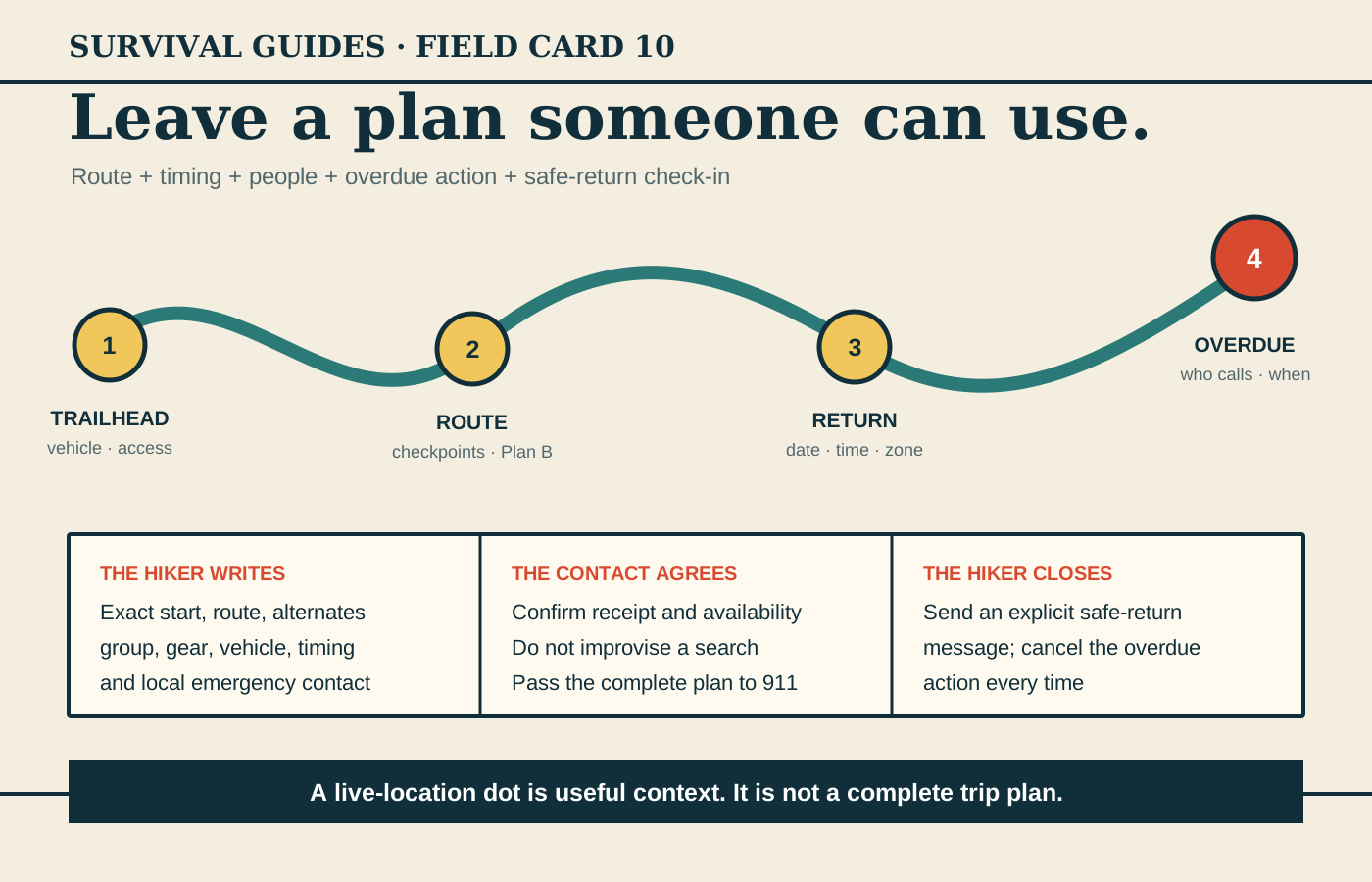
The best hiking trip plan is not the longest one. It is the one a person staying behind can understand, keep available, and hand to the right responder if you do not check in.
National Park Service hiking guidance repeatedly tells visitors to leave an itinerary with someone who will notice when they are overdue and contact emergency personnel. The NPS trip-planning program adds an important closing step: tell the trusted contact when the activity is complete. A current U.S. Forest Service trip-planning guide likewise tells visitors to share a trip plan with a trusted contact and to check in with that contact after the trip.
Those instructions sound simple until a real plan has to answer practical questions. Which trailhead? Which fork? Is the route a loop or an out-and-back? What vehicle should still be parked there? When does “late” become “overdue”? Who is in the group? What number should the contact call? A useful plan resolves those questions before the group leaves coverage.
Ask a specific person who is staying behind. Confirm that they received the plan, understand the time zone and overdue action, and will be available. A message sent to a muted group chat is not an agreement.
A trip plan creates a usable starting point
If a hiker is reported overdue, responders need more than a destination name. The same named trail can have several access points, side routes, seasonal closures, or parking areas. The hiker may have planned a turnaround, shuttle, alternate exit, or off-trail segment. Gates of the Arctic National Park's backcountry planning guidance lists the activity, party, route, transportation, equipment, communications, dates, and a precise instruction for when to initiate a search-and-rescue notification.
A trip plan does not guarantee rescue and does not replace the Ten Essentials, weather checks, navigation skill, permits, or sound decisions outside. It reduces uncertainty at the handoff between a trusted contact and responders. It also forces the hiking group to name assumptions that otherwise remain vague.
Use the plan for a day hike as well as an overnight trip. Short outings still involve missed turns, injuries, changing weather, vehicle trouble, or unexpected darkness. Scale the detail to the route, but preserve the same structure: where, who, when, how, what changed, and what happens if the plan is not closed.
Write the details that distinguish this trip
Prepare the plan while current maps, alerts, permit information, weather, road status, and transportation details are in front of you. Do not rely on memory at the trailhead. Store a copy where the group can reach it offline and send a copy to the trusted contact.
People
Full names, party size, useful identifying details, relevant support needs, and an emergency contact for each person when appropriate.
Place
Managing agency, exact trailhead, road or parking location, route direction, checkpoints, destination, alternates, and intended exit.
Time
Start, checkpoints, turnaround, expected return, check-in method, and overdue action time—each with date and time zone.
Equipment
Vehicle description and plate, shelter and clothing colors, navigation and communication devices, and known communication limits.
Include only personal and medical information that is relevant, lawful to share, and agreed to by the person. Protect the plan from casual public posting because it can contain names, travel timing, vehicle details, and other sensitive information. Give it directly to the trusted contact and, if needed, responders.
Write an emergency number or dispatch contact appropriate to the actual jurisdiction. In the United States, NPS guidance commonly directs people to call or text 911 when available. A park may also publish a ranger or dispatch number. Verify the current official contact for the location; do not copy a number from an old forum post.
Describe a route another person can trace
“North Ridge Trail” is not enough when the trail has two ends and several junctions. Start with the precise access point. Give the official trailhead name, managing agency, road, parking coordinates or map pin, and expected vehicle. Note a gate, shuttle, ferry, snow-park, permit station, or seasonal road if it controls access.
Then describe the intended direction in ordered legs. Use official trail names, junctions, water crossings, passes, camps, summits, and exit points. Add map coordinates where they clarify a checkpoint, but do not replace names and context with an unexplained string of numbers. State the coordinate format and datum if the plan depends on coordinates.
- Mark the start. Identify the exact trailhead, vehicle, parking location, and departure time.
- List route legs. Put checkpoints in travel order with the intended trail, direction, or destination.
- Name the turn. Record the turnaround point and the latest turnaround clock time.
- Explain alternatives. Name only the planned bailouts or alternate exits the group has actually evaluated.
- Mark the finish. State where the group will exit and how it will travel from there.
If the plan changes by design—for example, the group may choose Route A or Route B—write the decision point and how the trusted contact will learn which route was selected. An alternate that no one communicates can widen the search area rather than reduce it.
Connect the route to the site's map-and-compass workflow. The group should carry an appropriate map and navigation tools, not just send a map to someone at home. If location confidence is lost, use the STOP and last-known-location process rather than wandering to make the plan “come true.”
Use clock times, dates, and time zones
“Back by dinner” is ambiguous. Write the expected trailhead return as a date and clock time with the time zone. Add the method of the safe-return check-in: call, text, satellite message, or another agreed channel. Then write a separate overdue action time.
The overdue time is not a universal number of hours after the expected return. Terrain, weather, park hours, transportation, group capability, communication coverage, and local official guidance all matter. A delayed shuttle on a popular route is different from a missed check-in before a severe-weather window in remote terrain. Agree on a route-specific threshold before departure.
If there is evidence of immediate danger—an emergency message, witnessed injury, dangerous weather, or a known incident—the trusted contact should not wait for a routine overdue time simply because it is printed on the card. The plan should say that immediate evidence goes to emergency services promptly.
The site's daylight-budget guide helps set a return target, hard turnaround, and earlier checkpoints from the actual route and group pace. Copy those clock times into the trip plan so the trusted contact is holding the same schedule as the hikers.
Choose a trusted contact who accepts the role
The contact should be staying behind, reachable during the relevant period, able to open the plan, and willing to act. Confirm the plan in a two-way exchange. Ask the contact to repeat the expected return, overdue time, and first call. That quick read-back catches time-zone errors, missing attachments, and assumptions about who else is watching.
Give the contact a clean copy rather than a long conversation full of draft routes. Put the final version at the top and label it with the trip date. If several people receive the plan, name one primary contact and explain how the others coordinate. Multiple people assuming someone else has called can create delay; several uncoordinated calls can create confusion.
The trusted contact's job is to pass information to professionals, not to begin an improvised backcountry search. NPS emergency-planning guidance specifically warns against going off trail to look for a missing person. The contact should stay reachable, preserve messages and location data, and follow dispatcher instructions.
Write the overdue handoff as a short script
Do not make the contact invent the process under stress. Put a short action block on the plan:
Try the agreed check-in channels once. Then contact [verified agency or 911] and say that this party is overdue from the attached route. Provide the complete plan, last message, last known location, vehicle, communication devices, conditions, and any evidence of immediate danger. Do not leave the road or trail to search.
The contact should distinguish “last known” from “last assumed.” A location-sharing dot may be old. A delivered message may not prove that the sender remained at that location. Record the timestamp, source, and uncertainty when passing digital information to responders.
Keep phone and satellite-device details accurate. State the devices carried, service or identifier needed for a message, and whether two-way communication is expected. Do not promise coverage. NPS hiking guidance notes that cell service can be extremely limited and suggests considering a personal locator beacon. Device registration and emergency-contact records should be current before the trip.
Update the person holding the plan
A plan only helps when it matches the trip. If the group changes the trailhead, route, party, vehicle, expected return, or overnight location, send the change to the trusted contact and receive confirmation before proceeding when communication is available. Editing a private note on the hiker's phone does not update the copy at home.
Use a short version label: “Trip plan updated 11:20 a.m. PST: Route B selected at Pine Junction; expected return now 4:30 p.m.; overdue action remains 6:00 p.m.” Avoid erasing the earlier message. The sequence can help explain what changed and when.
When everyone is safe, close the plan explicitly. “Back at the car, all four people accounted for; close the plan” is clearer than a photo or an unrelated text. NPS trip-planning guidance tells visitors to notify their trusted contact after completing each activity. Make that final message part of every outing, including routine trips, so the habit is dependable.
Know what live location can and cannot do
Location sharing is useful supporting information. It may show progress, a last transmitted point, or a route deviation. It can also stop because of coverage, battery, settings, device damage, account access, or a service outage. A dot does not identify the full group, vehicle, alternate route, shelter, equipment, medical context, or agreed overdue action.
Send the written plan even when location sharing is enabled. Tell the contact which service is being used, what a stale timestamp looks like, and whether they can access it without a new login or code. Do not ask the contact to infer an emergency from normal gaps in tracking; use the written timing and escalation agreement.
If you do not have an obvious trusted contact
Do not quietly skip the planning step. Ask the managing park, forest, outfitter, guide service, permit office, or local law-enforcement agency whether it accepts trip plans or offers an official registration process. Some locations provide trail registers, backcountry permits, or formal trip-plan procedures; others do not monitor itineraries. Verify what the local system actually does.
A trail register is not automatically an overdue-alert service. It may help responders only after someone reports you missing. A social post is also a poor substitute: it may be public, vague, unseen, or missing the overdue instruction. An outdoor club, guide, housemate, coworker, or family member may be able to accept the contact role if the request is specific and they agree.
Public discussions show that people often struggle with this exact question, as well as how much route detail to include and whether an app is enough. Those discussions were used to identify questions, not to set emergency procedure. The recommendations here were checked against NPS and Forest Service guidance, and local agencies remain the authority for local reporting.
Practice: a 25-minute trip-plan handoff
Use a real upcoming local walk or a fictional route at home. Do not trigger emergency services as a drill.
- Open the official map, alerts, weather, access, and emergency-contact pages.
- Write the trailhead, vehicle, ordered route legs, checkpoints, turnaround, alternatives, and exit.
- Add the people, communication devices, equipment colors, expected return, and time zone.
- Choose an overdue time and write the exact verified contact and handoff steps.
- Send the plan to a willing partner and ask them to find the trailhead and repeat the timing.
- Correct anything they cannot interpret without asking you.
- Practice sending one route-change message and receiving confirmation.
- Finish with an explicit “safe and plan closed” message.
Frequently asked questions
What should a hiking trip plan include?
Include the group, exact trailhead and vehicle, intended route and alternatives, start and expected return with a time zone, equipment and communication methods, the agreed overdue action time, and who the trusted contact should call. Send changes and close the plan after the trip.
How late is late enough to call for help?
There is no universal grace period. Agree on a specific time and process for the route, group, conditions, communication limits, and local guidance. Evidence of immediate danger should be reported promptly rather than held until a routine deadline.
Is a shared tracking link enough?
No. Tracking can fail or go stale. The contact also needs the route, alternatives, people, vehicle, timing, equipment, communication limits, and overdue instructions.
Should my contact come looking for me?
No. Give the plan to the appropriate emergency service and follow dispatcher instructions. An untrained improvised search can place another person at risk and complicate the response.
Sources checked
Reviewed November 3, 2026.